The Role of Conveyors in the Leaching Process: From Feed to Recovery
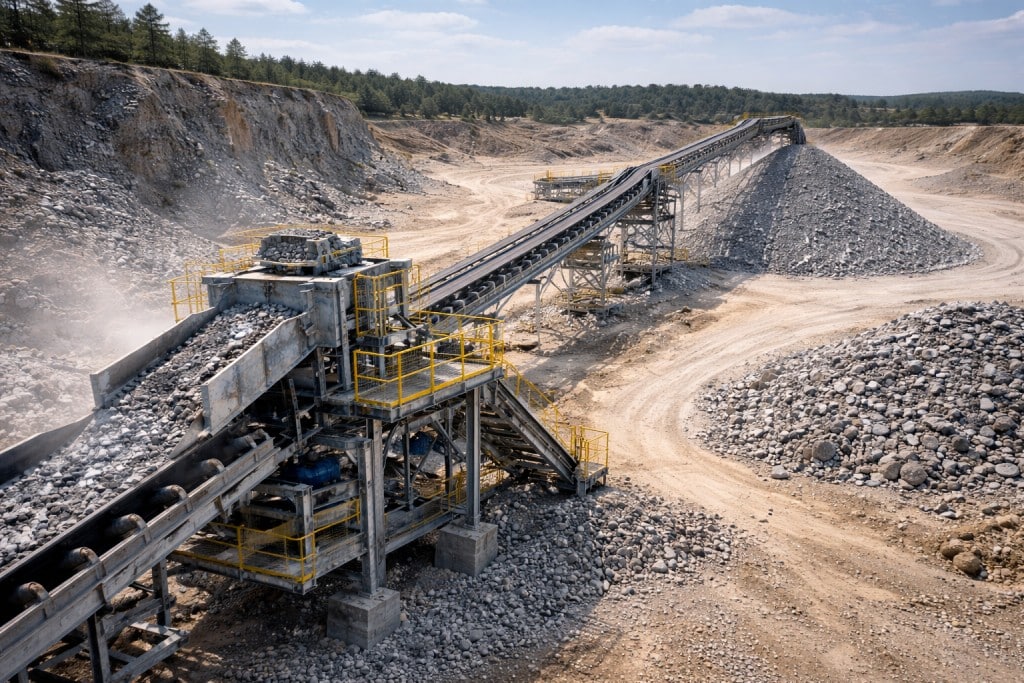
Leaching is often discussed in terms of chemistry—solutions, reactions, and recovery rates. But behind every successful operation is a material handling system that keeps everything moving at the right pace.
Understanding the role of conveyors in the leaching process starts with recognizing that leaching is not a single step. It’s a sequence. Material must move consistently from one stage to the next without interruption, bottlenecks, or inconsistencies in feed.
For many operations, that sequence starts inside the preparation plant, where material is crushed, screened, transferred, and staged before it reaches the leaching circuit.
That’s where conveyors come in. They provide the continuity needed to maintain steady throughput, ensuring each stage of the process receives material at the expected rate.
FROM PREPARATION PLANT TO LEACH: PREPARING AND FEEDING MATERIAL
Before material ever reaches a leach pad or tank, it must be transported from crushing and screening circuits.
At this stage, conveyors are responsible for:
- Moving material from crushers to stacking or feed systems
- Regulating flow into leach pads or processing tanks
- Maintaining a consistent feed rate to avoid overloading or starving downstream processes
- Moving material between preparation plant equipment before it enters the leaching circuit
If feed delivery fluctuates, it can disrupt how material is distributed across a leach pad or how slurry is introduced into tanks. That inconsistency can carry through the entire operation.
Inside the preparation plant, those fluctuations may start as plugged chutes, overloaded transfer points, inconsistent screen discharge, or irregular flow from stockpiles and bins.
This is often where operators begin to see how conveyors fit into the leaching process, not just as transport equipment, but as a way to stabilize input conditions.
FEEDING LEACH PADS AND TANKS WITH CONSISTENCY
Once material reaches the leaching stage, placement and distribution matter.
For heap leaching:
- Conveyors carry material to stacking systems
- They help maintain uniform lift height and layering
- Consistent flow supports even solution percolation
For tank leaching:
- Conveyors deliver material to feed points or transfer systems
- They help maintain a steady supply to agitation or mixing stages
In both cases, uneven feed creates uneven results. Some areas may receive too much material, while others receive too little, leading to inconsistent exposure to leaching solutions.
TRANSFERRING MATERIAL BETWEEN PROCESS STAGES
Leaching operations often involve multiple steps beyond the initial application of the solution. Material may move between:
- Intermediate processing stages
- Additional treatment points
- Separation or classification systems
Conveyors connect these stages, keeping material moving without unnecessary delays.
If transfer points aren’t coordinated properly:
- Material can accumulate at certain stages
- Throughput slows down across the system
- Downstream equipment may not receive material at the required rate
This is why conveyors aren’t just individual components. They function as a network that links each stage together.
SUPPORTING POST-LEACH MATERIAL HANDLING
After leaching, material still needs to be moved, whether for further processing, disposal, or recovery.
At this stage, conveyors are used to:
- Transport spent ore away from leach pads
- Move processed material to recovery or disposal areas
- Maintain steady flow into final handling systems
Depending on the operation, conveyors may also move material back into plant areas for additional handling, separation, disposal, or recovery-related processing.
Even though the chemical process is complete, consistent material movement remains critical. Any slowdown or interruption can impact overall production efficiency.
HOW CONVEYOR PERFORMANCE IMPACTS THE ENTIRE PROCESS
Across every stage, from feed to recovery, one factor remains constant: consistency.
When conveyors operate smoothly:
- Material moves at a predictable rate
- Each stage receives the expected volume
- The overall process remains balanced
When performance is inconsistent:
- Bottlenecks form between stages
- Some areas are overfed, while others are underfed
- Efficiency drops across the operation
In a preparation plant, those ripple effects can show up as equipment waiting on material, overloaded receiving points, excess cleanup, or inconsistent feed into the leaching circuit.
This is why conveyor systems play such a direct role in process outcomes. Even small variations in flow can have ripple effects throughout the leaching cycle.
INTEGRATING CONVEYORS INTO THE FULL LEACHING FLOW
Leaching systems rely on coordination. Each stage depends on the one before it, and conveyors are what keep that sequence intact.
Designing conveyors for these applications isn’t just about moving material from point A to point B. It’s about:
- Matching conveyor capacity to process requirements
- Aligning transfer points with process flow
- Maintaining consistent throughput across all stages
When conveyors are properly integrated into the broader system, operations run more smoothly and predictably.
KEEP YOUR LEACHING PROCESS MOVING
Leaching performance depends on more than chemistry—it depends on how reliably material moves through each stage of the process.
West River Conveyors works with mining operations and preparation plants to develop conveyor systems that support continuous, balanced material flow from feed through recovery. With a focus on integration and real-world operating conditions, our team helps ensure your system performs as intended across every phase.