Impact, Abrasion & Wear: Designing Conveyor Chutes That Last
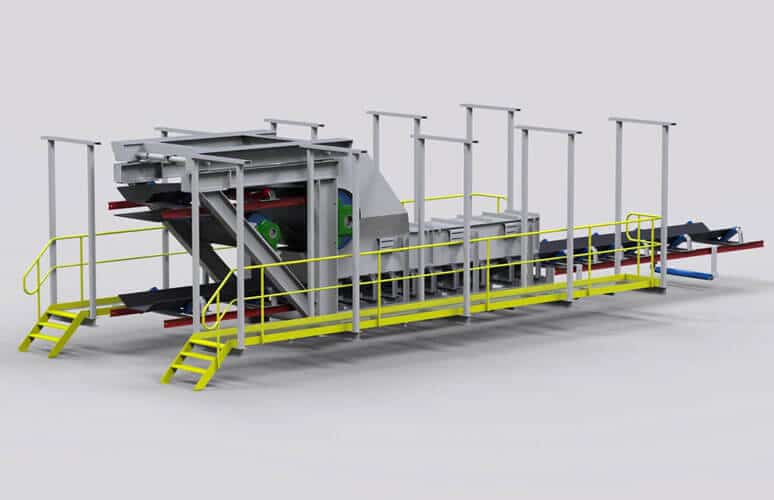
In mining operations, conveyor transfer chutes operate in some of the harshest conditions in the plant. They absorb high-impact loads, guide abrasive material, and endure constant wear, all while supporting system uptime and safety. When chutes fail prematurely, the result is not just liner replacement, but increased downtime, maintenance labor, and long-term operating costs.
Designing conveyor chutes that last requires more than thicker steel or harder liners. It demands a deeper understanding of how impact forces, material characteristics, and chute geometry work together, and how poor design accelerates wear rather than preventing it.
HOW CONVEYOR CHUTES HANDLE IMPACT & WHY MANY FAIL
Impact is the first and most destructive force acting on a transfer chute. When material drops from one conveyor to another, kinetic energy is released at the point of contact. If that energy is not properly managed, it concentrates in small areas, rapidly degrading chute surfaces and liners.
Poorly designed chutes often allow material to:
- Free-fall from excessive heights
- Strike flat or improperly angled surfaces
- Impact the same location repeatedly
These conditions create localized wear zones, cracking, liner delamination, and structural deformation. Over time, impact damage spreads downstream as material rebounds and scours secondary surfaces.
Effective chute design focuses on how conveyor chutes handle impact, not by resisting energy with brute force, but by controlling and dissipating it.
WHERE WEAR OCCURS INSIDE TRANSFER CHUTES
Wear inside a transfer chute is rarely uniform. Instead, it follows predictable patterns based on material flow and energy concentration.
Common high-wear areas include:
- Initial impact zones where material first contacts the chute
- Transition surfaces where material changes direction
- Areas of turbulence where material accelerates or decelerates
- Discharge points where material exits onto the receiving belt
Without proper flow control, material repeatedly contacts the same surfaces, accelerating abrasion and reducing liner life. Understanding where wear occurs is critical to designing chutes that survive long-term operation.
HOW MATERIAL CHARACTERISTICS DRIVE ABRASION & WEAR
Not all materials behave the same inside a chute. Material characteristics play a major role in determining how to avoid abrasion of conveyor chutes and extend service life.
Key factors include:
- Abrasiveness – Sharp, hard particles grind away liner surfaces
- Weight and density – Heavier material increases impact force
- Particle shape – Angular material cuts and gouges surfaces
- Velocity – Faster-moving material amplifies both impact and abrasion
- Fines content – Material in its broken-down or fine form can act like sandpaper, gradually grinding down wear liners and accelerating thinning over time
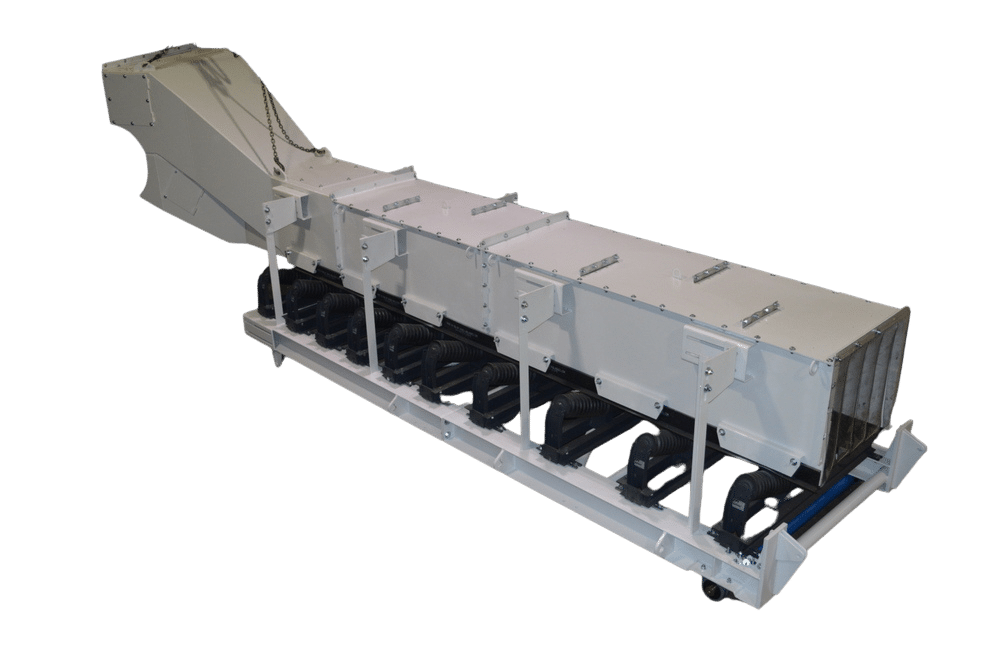
While coarse material often gets the most attention in chute design, fines can be just as damaging—especially when they are consistently present in the material stream.
When these factors are not accounted for, even high-quality liners can fail prematurely. Matching chute design and liner selection to the actual material being conveyed is essential for durability.
WHY “ADDING THICKER STEEL” OFTEN FAILS
A common misconception is that thicker steel automatically leads to longer chute life. In practice, adding thickness without addressing flow dynamics often increases cost without solving the problem.
Thicker steel may:
- Absorb impact without cracking—but still wear rapidly
- Transfer energy into adjacent structures
- Mask underlying flow issues rather than correcting them
In many cases, no matter how “beefy” the material selection is—whether thicker steel or AR plate—if material flow is not properly controlled, the same impact zones will wear out. The problem is not the material strength, but where and how the material is hitting the chute.
Without proper geometry and energy management, impact and abrasion simply shift to another area of the chute. Longevity comes from designing for wear, not just resisting it.
DESIGNING CONVEYOR CHUTES THAT RESIST ABRASION & WEAR
To understand how to avoid wear of conveyor chutes, it’s important to look at the system holistically. Durable chute designs balance three critical elements:
CHUTE GEOMETRY
Proper angles and contours guide material smoothly, minimizing abrupt impacts and turbulent flow. Geometry plays a major role in reducing sliding abrasion and repeated contact with chute surfaces.
LINER SELECTION
Different wear zones require different liner solutions. High-impact areas may require materials designed to absorb energy, while high-abrasion zones benefit from liners that resist grinding and cutting forces.
ENERGY DISSIPATION
Rather than stopping material abruptly, effective designs manage velocity and distribute impact energy across larger areas, reducing localized wear and extending liner life.
When these elements are aligned, conveyor chutes last longer, require fewer repairs, and deliver lower lifecycle costs.
ENGINEERED FOR LONGEVITY, NOT JUST INSTALLATION
At West River Conveyors, transfer chutes are engineered with durability as the primary objective. Instead of relying on generic designs, WRC develops custom chute solutions based on real operating conditions, material behavior, and long-term maintenance considerations.
This engineering-first approach delivers:
- Extended liner life
- Reduced maintenance frequency
- Lower total cost of ownership
- Chutes built to survive harsh mining environments
By focusing on impact control, abrasion resistance, and wear management from the start, WRC designs conveyor chutes that last, even in the most demanding applications.
BUILDING CHUTES THAT STAND UP TO IMPACT & ABRASION
Impact forces and abrasive materials are unavoidable in mining operations, but premature chute failure is not. Understanding how conveyor chutes handle impact and how to avoid abrasion and wear of conveyor chutes starts with proper engineering—not thicker steel or reactive fixes.
Through custom chute geometry, application-specific liner selection, and energy dissipation strategies, long-lasting transfer chutes protect equipment, reduce maintenance, and deliver real lifecycle cost savings.
With deep mining expertise and a system-level design approach, WRC engineers chute solutions built to withstand impact, resist abrasion, and perform reliably over the long haul.