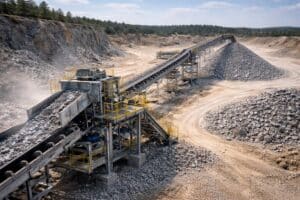
How Chute Geometry Affects Mining Conveyor Performance
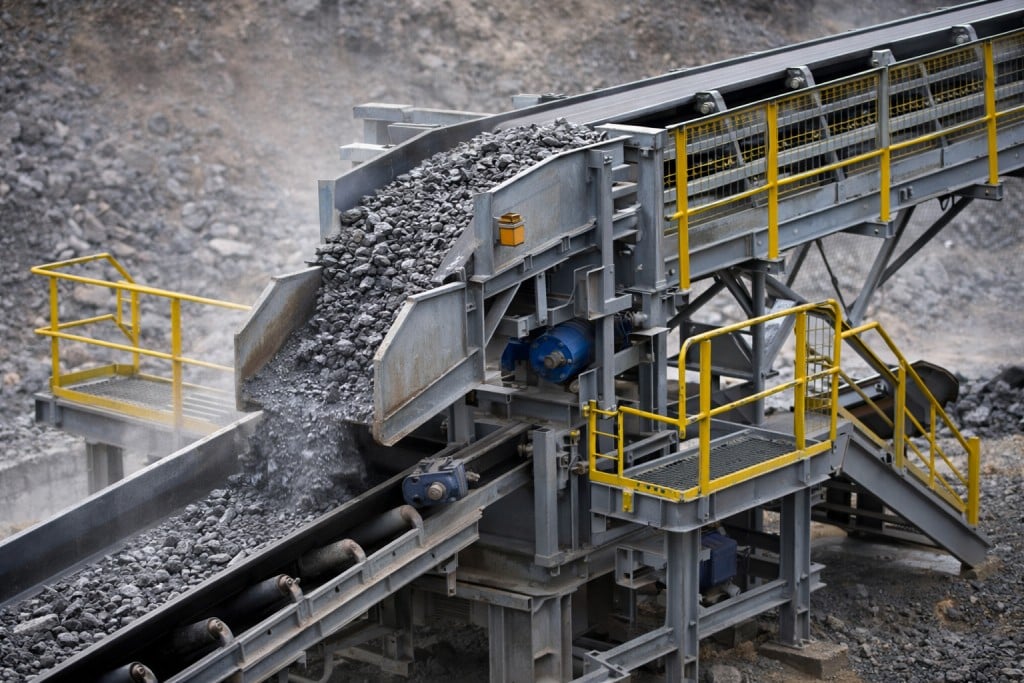
When a conveyor system isn’t performing as expected, the first instinct is often to look at belt speed, capacity, or wear components. But in many cases, the issue starts upstream—inside the transfer chute. This is especially true in preparation plants, where material is constantly transferred between conveyors, screens, crushers, bins, and other processing equipment.
Understanding how chute geometry affects mining conveyor performance is critical because even small dimensional mismatches can disrupt material flow. A chute that looks “close enough” on paper can still create spillage, buildup, or uneven loading once it’s in operation.
Transfer chutes are responsible for guiding material from one conveyor to the next, or from plant equipment such as screens, crushers, bins, and hoppers onto a receiving conveyor, while maintaining a consistent, centered stream. If that flow isn’t controlled properly, downstream equipment pays the price.
HOW WIDTH, ANGLE, AND SHAPE CONTROL MATERIAL FLOW
Chute geometry isn’t just about fitting between two conveyors. It directly influences how material behaves in motion.
WIDTH: TOO NARROW VS. TOO WIDE
Chute width determines how freely material can pass through the system.
If the chute is too narrow:
- Material begins to crowd and restrict itself
- Flow slows down or becomes inconsistent
- Plugging becomes more likely, especially with mixed particle sizes
This is often the first sign when evaluating how to know if your conveyor chute is too narrow. You’ll see buildup forming along the walls or intermittent blockages.
If the chute is too wide:
- Material spreads out instead of staying centralized
- The stream loses cohesion before reaching the receiving belt
- Loading becomes uneven, increasing the risk of mistracking
In these cases, operators questioning how to know if your conveyor chute is too wide often notice material landing off-center or drifting across the belt.
The goal isn’t maximum space—it’s controlled flow.
ANGLE: CONTROLLING VELOCITY AND TRAJECTORY
The chute angle dictates how quickly material accelerates and where it lands on the next conveyor.
If the angle is too shallow:
- Material may slow down or stall
- Fines can accumulate and lead to packing
- Flow becomes inconsistent over time
If the angle is too steep:
- Material accelerates too quickly
- The trajectory becomes harder to control
- Material can overshoot the intended loading zone
Proper chute angle keeps material moving at a steady, predictable rate so it transitions smoothly between conveyors. For preparation plants, the right chute angle is especially important at high-volume transfer points where inconsistent flow can quickly affect screens, crushers, storage areas, or downstream conveyors.
When that alignment is off, material trajectory becomes increasingly difficult to predict, especially when transfer points and conveyor transition design aren’t properly aligned.
INTERNAL SHAPE: GUIDING THE MATERIAL STREAM
The internal profile of a chute determines how material is directed as it travels through.
Flat or poorly contoured surfaces can:
- Cause material to bounce or deflect unpredictably
- Break apart the flow stream
- Lead to off-center loading on the receiving belt
Well-designed internal geometry helps:
- Maintain a consistent material trajectory
- Funnel material into a centralized stream
- Reduce turbulence during transfer
Inside preparation plants, smoother internal flow can also reduce cleanup around transfer points and help maintenance teams access equipment without fighting constant buildup.
This is especially important because transfer chutes must discharge material in line with the receiving conveyor to avoid spillage and inefficiency.
COMMON SIGNS YOUR CHUTE GEOMETRY IS WRONG
Chute issues don’t always point directly to geometry, but the symptoms are usually clear once you know what to look for.
If you’re asking how to know if your conveyor chute geometry is wrong, watch for:
- Persistent spillage at the transfer point
- Material buildup along chute walls
- Frequent plugging or restricted flow
- Uneven belt loading or off-center discharge
- Conveyor mistracking shortly after loading
In preparation plants, these symptoms may also appear as plugged chutes between processing stages, overloaded receiving belts, uneven feed into screens, or recurring cleanup around the same transfer point.
These problems often occur even when the rest of the system is functioning properly. That’s what makes geometry issues so frustrating. They hide in plain sight.
WHY “CLOSE ENOUGH” DOESN’T WORK
In mining operations, variability is constant. Material size, moisture content, and throughput can all fluctuate, which means chute design needs to account for real-world conditions, not just ideal ones.
Preparation plants often amplify that variability because material may change as it moves through crushing, screening, washing, or stockpiling.
A chute that’s slightly undersized or improperly angled might work at low capacity but fail under peak loads. Over time, those inefficiencies turn into:
- Increased cleanup and maintenance
- Reduced throughput
- Greater strain on downstream components
Chute sizing and geometry should be treated as a calculated part of the system, not an afterthought.
HOW WEST RIVER CONVEYORS APPROACHES CHUTE DESIGN
West River Conveyors takes a tailored approach to chute geometry, focusing on how material actually behaves within a given system.
Rather than relying on standard dimensions, each chute is developed based on:
- Material characteristics (size, density, variability)
- Required tonnage and flow rate
- Conveyor and plant layout, including height, transfer angle, surrounding equipment, and available space
This approach helps maintain a controlled material stream from one conveyor to the next, reducing the likelihood of spillage, plugging, or uneven loading.
Because transfer points are where many conveyor issues originate, getting the geometry right up front leads to more stable, predictable performance across the entire system.
GET YOUR TRANSFER POINTS WORKING THE WAY THEY SHOULD
Chute geometry plays a larger role than most operations expect. When dimensions, angles, and internal shape are aligned with real operating conditions, material moves consistently, and the rest of the system follows suit.
West River Conveyors specializes in custom transfer chute solutions built for demanding mining and preparation plant environments. If you’re dealing with ongoing flow issues or planning a new system, it’s worth taking a closer look at your transfer points.